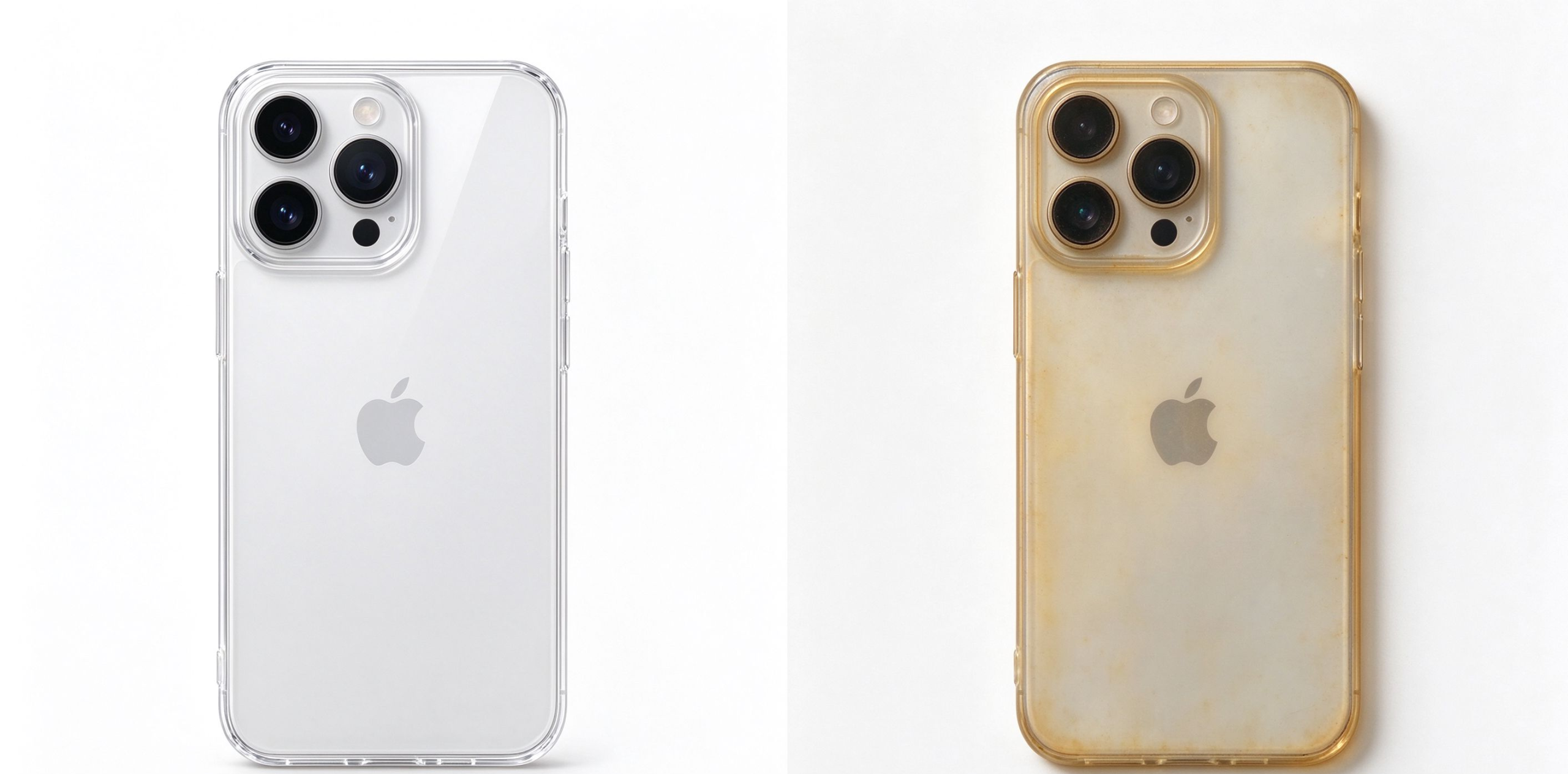
I bought my first clear phone case a few months ago because I wanted to show off the natural color of my new phone. By month three, it looked like it had been sitting in a sunny window for a year — dull, foggy, and distinctly yellow.
I went down the internet rabbit hole trying every “hack” I could find: baking soda, toothpaste scrubbing, hydrogen peroxide, even a white-vinegar soak. Some worked a little. Most did nothing. The toothpaste one actually left my case covered in tiny scratches that looked even worse than the yellowing.
After wasting an entire Sunday on this, I figured out the hard way: not all “yellowing” is the same, and not every method is worth trying. Let me save you the same frustration.
First: Diagnose What Kind of Yellowing You Have
Before you reach for any cleaning supplies, spend 30 seconds figuring out what you’re actually dealing with. The wrong approach wastes time and can damage your case further.
① Feels oily, cloudy, fingerprint smudges visible → Just dirt. Dish soap and water will fix it completely.
② Even yellow tint across the whole case, still feels smooth → Surface-level yellowing from UV exposure and skin oils. Baking soda or a gentle hydrogen peroxide soak can help.
③ Edges (the soft TPU bumper) more yellow than the back, feels slightly brittle → Material degradation. No cleaning method will fix this. I explain exactly why this happens in my breakdown of why clear phone cases turn yellow.
If you landed in category 3, you can stop reading here — the rest of this guide won’t help you. Skip to the last section where I tell you when it’s just better to buy a new case.
Quick Method Comparison
Here’s the short version before we dive into each method:
| Method | Best For | Expected Result | Difficulty | Safety |
| Dish soap + warm water | Everyday grime, surface dirt | Restores 80-90% of clarity | ⭐ | Safest option |
| Baking soda scrub | Mild surface yellowing | Improves 50-70% of appearance | ⭐⭐ | Safe for all materials |
| Hydrogen peroxide soak | Moderate yellowing | Lightens 30-50%, won’t fully restore | ⭐⭐ | Use with caution |
| White toothpaste | Not recommended | Does NOT fix yellowing, leaves micro-scratches | ⭐⭐ | Risk of permanently scuffing the surface |
| Isopropyl alcohol wipe | Disinfecting, cutting grease | No effect on yellowing | ⭐ | Can damage coatings and TPU edges |
Now let’s walk through each one properly.
Method 1: Dish Soap + Warm Water (Start Here)
This should be your first step, every time. It’s the gentlest method, and it’s enough for 90% of people who just think their case is “yellowed” but actually just has months of hand oil and pocket lint built up.
What you need:
- Mild dish soap (not antibacterial with moisturizers — plain blue Dawn works fine)
- Warm (not hot) water
- A soft microfiber cloth or a very soft-bristled toothbrush
- A towel for drying
Steps:
- Take the case completely off your phone. This seems obvious but I’ve seen people try to wash it while it’s still on. Don’t do that.
- Mix a few drops of dish soap into a bowl of warm water.
- Dip your cloth or toothbrush in, and gently scrub the entire case — both inside and outside. Pay extra attention to the edges and corners where dust collects.
- Rinse thoroughly under warm running water until all soap residue is gone.
- Pat dry with a clean towel, then let it air dry completely for at least 30 minutes before putting your phone back in.
My honest take: This won’t fix true yellowing, but you’d be surprised how many cases just needed a good wash. I thought my case was permanently yellowed until I did this — turns out half of the “yellow” was just months of invisible hand oil building up.
Method 2: Baking Soda Scrub (For Mild Yellowing)
If after washing the case still has a yellow tint, baking soda is your next step. It’s a mild abrasive that lifts surface discoloration without scratching the plastic.
What you need:
- Baking soda (regular kitchen baking soda, not the fancy kind)
- A little water
- A soft-bristled toothbrush
- Warm water for rinsing
Steps:
- Remove the case and rinse it under warm water to get the surface wet.
- Sprinkle a thin layer of baking soda directly onto the yellowed areas. You can also mix it with a few drops of water to make a thick paste if you prefer.
- Use the soft toothbrush to gently scrub in small circular motions. Don’t press hard — let the baking soda do the work. Scrub for about 2-3 minutes on the worst areas.
- Let the baking soda paste sit on the case for 10-15 minutes. This gives it time to lift the discoloration.
- Rinse thoroughly with warm water, making sure all baking soda is washed out of the corners and edges.
- Pat dry and air dry completely.
My honest take: This improved my case noticeably — it went from a distinct yellow tint to a much paler, almost off-white color. It didn’t make it look brand new, but it bought me another month or two of use. This method works best on yellowing that’s only a few months old.
Method 3: Hydrogen Peroxide Soak (For Stubborn Yellowing)
If baking soda didn’t do enough, hydrogen peroxide is the “nuclear option” for home methods. It’s a mild bleaching agent, and it can lighten yellowed TPU. But it’s also the method most likely to cause damage if you’re not careful.
Important disclaimer first: This works on surface-level UV discoloration. It will not reverse deep material degradation. If your case is in category 3 from the diagnostic section above, skip this — you’re just wasting peroxide.
What you need:
- 3% hydrogen peroxide (the regular brown bottle kind from any pharmacy — don’t use anything stronger)
- A clear plastic container or bowl (something you don’t care about staining)
- Warm water
- Gloves (optional, but the peroxide can dry out your skin)
Steps:
- Remove the case and give it a quick wash with dish soap first. You want to get all surface oil off before soaking.
- Place the case in your plastic container. Pour in enough hydrogen peroxide to completely submerge it. If your case floats, weigh it down with a small clean object.
- Optional: place the container in a sunny spot. The UV light from the sun plus the peroxide creates a stronger bleaching reaction. This is actually the trick that most “hacks” leave out.
- Let it soak. I’d start with 2 hours, then check progress. Some guides say overnight — but I’d avoid soaking longer than 4-6 hours at most, because prolonged exposure can weaken the TPU over time.
- Remove the case and rinse very thoroughly with warm water. Rinse inside and out, making sure no peroxide residue is left.
- Air dry completely.
My honest take: This helped more than baking soda, but it still didn’t make my case fully clear. I’d say it lightened the yellow by about 40-50%. The case looked “less yellow” but still clearly aged. Worth trying if you’ve already committed to the case, but don’t expect a miracle.
Safety notes:
- Don’t use bleach. Chlorine bleach will destroy TPU and can make yellowing worse.
- Don’t heat the peroxide or use a concentration higher than 3%.
- Don’t soak cases with printed designs or coatings — the peroxide will strip those right off.
What NOT to Do: 6 Mistakes That Make Yellowing Worse
I’ve seen all of these recommended online. Don’t do them. I learned most of these the hard way.
1. Don’t scrub with toothpaste. I tried this one myself — it seems harmless, right? Toothpaste is just mild abrasive, the internet says. But after two minutes of gentle scrubbing with a soft toothbrush, my case was covered in tiny micro-scratches all over the back. It didn’t remove the yellow at all, and now it looked foggy and scuffed on top of being yellow. I was more upset about the scratches than the original yellowing. Skip it.
2. Don’t use rubbing alcohol as a soak. Alcohol will cut through oil and disinfect, but soaking a TPU case in isopropyl alcohol will turn the soft edges cloudy and hazy permanently. You can use a 70% alcohol wipe very lightly on the hard plastic back panel if you need to disinfect, but never submerge the whole case.
3. Don’t use bleach. Chlorine bleach is too aggressive for phone case materials. It will not only fail to remove yellowing — it can actually accelerate the degradation process and make the case more brittle.
4. Don’t use acetone or nail polish remover. This will literally dissolve TPU. Even a quick wipe can leave a permanently hazy, melted-looking spot on your case.
5. Don’t use boiling water, the dishwasher, or a hairdryer. Heat warps and distorts plastic. You’ll end up with a warped case that doesn’t fit your phone anymore, on top of the yellowing.
6. Don’t scrub hard with an abrasive sponge or stiff brush. Scratches on a clear case aren’t just ugly — they create tiny grooves that trap more dirt and oil, making the case yellow faster over time. Stick to soft brushes and microfiber cloths.
Why Nothing I Tried Worked? It’s Time to Replace It
Here’s the truth nobody tells you: most yellowed clear cases can’t be fully fixed.
If you’ve tried all three methods above and your case still looks noticeably yellow, that’s not a cleaning failure — that’s the material reaching the end of its lifespan.
TPU (the soft, flexible material used in most clear cases) breaks down from UV exposure, skin oils, and oxygen over time. The chemical changes happen at the molecular level inside the plastic. You can clean the surface all you want, but you can’t reverse that internal degradation.
[Outbound link: add hyperlink on “TPU” to https://en.wikipedia.org/wiki/Thermoplastic_polyurethane]
At this point, you have two options:
- Keep using a case that looks yellowed (totally fine if you don’t care about looks)
- Buy a new one — ideally one that’s designed to resist yellowing
If you’re going to replace it anyway, you might as well get one that’s going to last longer. I tested six popular clear cases for iPhone 18 series and tracked which ones stayed clear the longest. You can see the full roundup of the best clear iPhone 18 Pro cases there — the top picks use harder polycarbonate backs with anti-yellowing coatings that hold up much better than cheap TPU-only cases.
Quick Tips to Prevent Yellowing in the First Place
Cleaning is reactive — prevention is easier. Here are the small habits that will make your next clear case last longer:
- Take it off and wash it with soap every 2-3 weeks. This removes the skin oils that accelerate yellowing before they can react with the material.
- Don’t leave your phone in direct sunlight for hours. Your car’s dashboard on a hot day is the #1 way to age a clear case in weeks.
- Wipe the inside of the case too. Dust and pocket lint get trapped between the case and your phone, and they trap moisture against the plastic.
- Don’t set your phone screen-down on rough surfaces. Scratches aren’t just ugly — they give UV rays and oil more places to penetrate the material.
- If you’re buying a new one, look for “anti-yellowing” or “UV-resistant” in the product specs. Cases with these coatings cost a few dollars more but last months longer. I’ve tested a few of the best ones in my roundup of clear iPhone 18 cases if you want a head start.
(I’m planning a deeper guide on how to prevent clear case yellowing soon — I’ll link it here once it’s up.)
FAQ
Q: Can you reverse yellowing on a clear phone case?
Partially, yes — but only for surface-level yellowing from UV exposure and oil buildup. Once the TPU material itself has chemically degraded (usually after 6+ months), the yellowing is permanent and no cleaning method will fully restore it.
Q: Does hydrogen peroxide really work on yellowed phone cases?
It can lighten moderate yellowing by about 30-50%, but it won’t make the case look brand new. It works best on younger yellowing (under 3-4 months old). Don’t soak for more than a few hours, as prolonged exposure can weaken the plastic.
Q: How long does it take for a clear case to turn yellow?
It depends on the material and how you use it. Cheap TPU cases can start yellowing in as little as 2-3 months, especially if you use your phone outside a lot or leave it in hot cars. Higher-quality polycarbonate cases with anti-yellowing coatings can stay clear for 6-12 months. I break down the material science in my article on why clear phone cases turn yellow.
Q: Is it worth cleaning a yellowed case or just buying a new one?
If the case cost you under $15 and it’s been more than 6 months old, just buy a new one. The time you spend cleaning it isn’t worth the marginal improvement. If it’s a nicer case ($30+) or it’s only a few months old, try the baking soda method first — it’s cheap and takes 15 minutes.
Q: Does toothpaste work to clean yellowed clear cases?
No — I tried this one myself and it was the biggest waste of time. It didn’t remove any of the yellowing, and the mild abrasives in toothpaste left my whole case covered in tiny micro-scratches that made it look foggy and scuffed. You’re better off using baking soda, which is less abrasive and actually does something for surface yellowing. Just skip the toothpaste hack entirely.
Disclaimer
This article contains affiliate links, which means I may earn a small commission if you click through and make a purchase — at no extra cost to you. As an Amazon Associate I earn from qualifying purchases. This helps me keep this site running and testing more products for you. All opinions in this article are my own, based on my own testing experience.